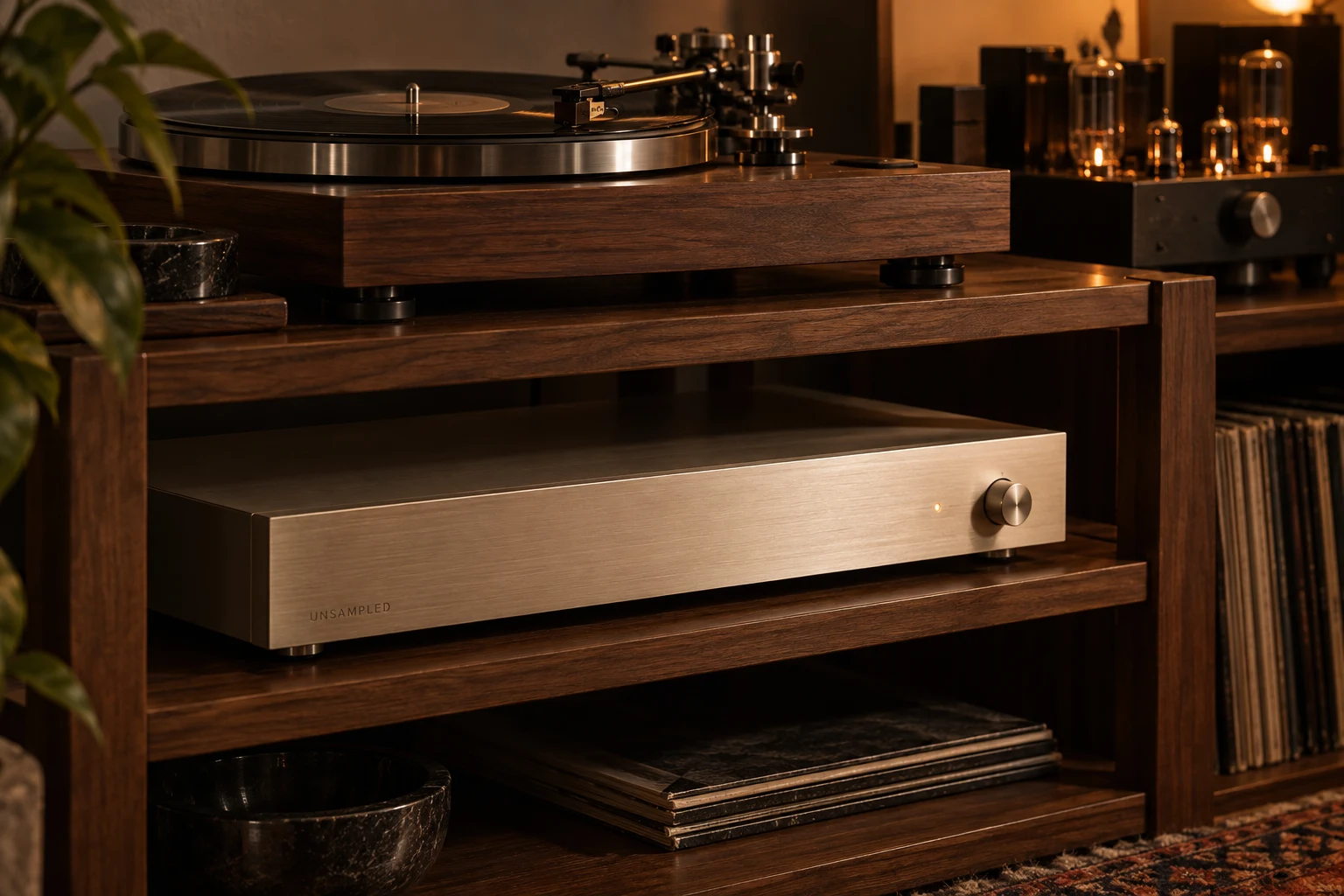
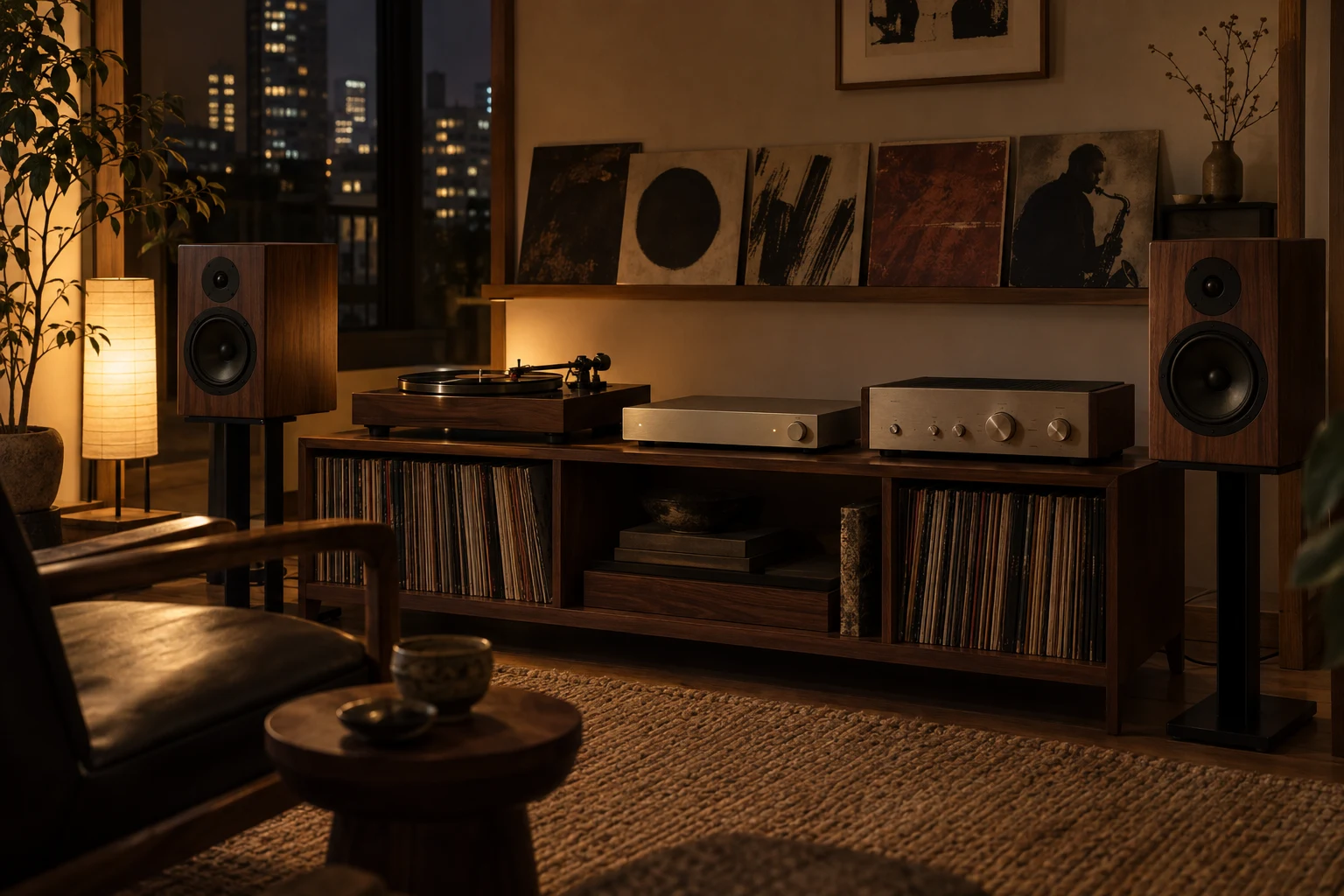
Unsampled  ·  automated analog room correction

Room correction that never digitizes your music.

Your room is the biggest error in your system — it swings the response at your listening seat by ±10 dB or more. Unsampled corrects it in pure analog: measured by an app, fixed by analog filters. Your signal never becomes a sample — not in this box.

Reserve your unit — $75, fully refundable

Target price $2,995 (excl. tax & shipping)  ·  Fully refundable any time before your unit ships  ·  In development — you approve final specs and price before paying anything beyond the deposit

Your room, measured Corrected — in analog (simulated) 20 Hz – 300 Hz
Illustrative simulation, not a production measurement. The peaks are corrected; the null near 50 Hz remains — EQ can't fix nulls, and we don't claim to.

The problem nobody automated for you

Below 300 Hz, a typical listening room imposes peaks of +6–10 dB and nulls deeper still — a larger error than the differences you've spent years voicing your system to achieve.

Analog room EQ isn't new. The Rives PARC proved it two decades ago, and mastering-grade analog parametrics have always existed — if you were willing to tune them by ear, with no measurement and no recall. But nothing measures your room and sets itself. Every automated correction system on the market digitizes your signal to do it: analog in, converter, DSP, converter, analog out.

If you've spent years keeping converters out of your vinyl path, that was never a trade you were willing to make. Automated correction with the path left analog — that's the gap Unsampled closes.

How it works

Digital where it thinks. Analog where it matters.

1

Measure

Place the individually calibrated USB measurement microphone at your listening seat, then at a few positions around it. The app sweeps your speakers and corrects what's common to all of them — not the quirks of one point in space. The mic's unique calibration file is applied automatically.

2

Compute

The app identifies your room's dominant modal peaks below ~300 Hz and computes a parametric correction curve. Correction is cut-focused — the system will not boost into nulls, which wastes amplifier headroom and punishes woofers. And it never applies narrow-band EQ from an in-room curve above the room's transition band — that isn't correction up there, it's damage.

3

Correct — in analog

The curve is written to Unsampled's digitally controlled, fully analog parametric EQ — [planned: relay-switched precision filter networks; no VCAs, no digital potentiometers in the audio path]. After configuration the control section latches and goes quiet; the USB interface is galvanically isolated. The control signals are digital. The audio path never is.

4

Voice — to taste

Not every band is spent on your room. One high-frequency band is reserved for you: a broad, gentle analog shelf for character — a touch more air, a slightly brighter presentation, a softer top for a lively room. Set it by ear, save it, recall it by name. The bass is science. The top end is yours.

Turntable Phono stage UNSAMPLED · analog EQ Amplifier Speakers
App connects here — digital control only, over isolated USB. It never touches the audio. Measurement sweeps play through your system only during setup; the measurement chain is not your listening chain, and nothing from it remains in the signal path.

What we claim — and what we don't

We claim

  • A 100% analog audio path. No ADC, DSP, or DAC ever touches the music.
  • Automated correction of bass peaks — where rooms do the most audible damage — plus one high-frequency band reserved for your taste, not our measurement.
  • Instant recall and app control on a fully analog filter network — with measured performance (THD+N, noise floor, bypass-vs-engaged delta) published before you pay a cent beyond the deposit.

We don't claim

  • That analog EQ "corrects better" than DSP. A minimum-phase analog filter and its digital twin measure the same.
  • That we correct phase, timing, or deep nulls. That requires DSP — which we deliberately don't use.
  • That the brains aren't digital. They are — and we'll show you exactly where.
We built Unsampled for one listener: the one who wants the room fixed and the signal path left alone.

Three ways to fix a room

DSP correction
Dirac · miniDSP · Trinnov
Manual analog EQ
GML · SPL
Unsampled
100% analog signal path
Automated room measurement
Computed correction curve
Instant recall & app control
Phase & timing correction
Deep nulls & multi-sub integration
Typical price$450–$12,000+$2,000–$9,500$2,995 target

Yes, we put the rows we lose in the table. Both alternatives are excellent at what they do — if digitizing your signal doesn't bother you, buy the DSP box, sincerely. Unsampled exists for when it does.

Who's behind this

MM
GM

Matt Marrin & Greg Morgenstein — Grammy Award–winning audio engineers with 25 years in professional audio, founders of HEAR360.

There's no factory and no finished chassis behind this page — deliberately. [Honest status: e.g., "There is a working measurement engine and a digitally-controlled analog EQ platform on our bench."] We're validating demand before we build, and your reservation is how we know. If that candor bothers you, the email list below is free.

Unsampled is a project of HEAR360 INC., Los Angeles, CA. Questions? Email Matt directly: matt@hear360.io.

First production run

Reserve your place

$2,995 target price · excl. tax & shipping

Reserve with a $75 deposit — fully refundable any time before your unit ships. Your $75 is applied to your balance, and reservation holders get the lowest first-run price we offer anyone. If the final price differs from the target, you'll know before you owe anything — confirm, or take a full automatic refund.

The first run needs 100 reservations. Build/no-build decision by December 31, 2026. If we're short, every deposit is refunded to your original payment method within 5–10 business days — automatically. (If a card refund fails — expired card, say — we'll email you and sort it.)

Reserve your unit — $75, fully refundable

Fully refundable any time before your unit ships  ·  Balance charged only after you confirm, via a fresh checkout — we don't keep your card on file  ·  You're holding a place, not committing to buy  ·  Secure checkout via Stripe — we never see your card number

Unsampled is in development. Specifications on this page describe the planned first production run and may change; you approve final specifications and price before paying anything beyond the deposit.

Questions you should ask

Does any part of my music get digitized?

No. The audio path is 100% analog from input to output. Only the measurement (a separate microphone) and the control signals are digital — and neither is in the path the music travels.

Why should I trust "100% analog"?

Because it will be verifiable, not just printed. Before anyone pays a balance, we publish the full audio-path schematic. Every production unit can be tested by its owner: pass a high-frequency tone through it — no brickwall filter; FFT the noise floor — no quantization floor, no sample-clock spurs; latency indistinguishable from a wire. Third-party measurement and teardowns are welcome. We're glad to be held to that standard.

What does Unsampled itself do to my signal?

The fair question — you've spent years keeping boxes out of your chain. Full measurements (THD+N, noise floor, and the bypass-vs-engaged delta) will be published before any balance is charged, and the unit has a true hardware bypass relay: bypassed means a wire, even powered off.

Is anything digital running while I listen?

[Planned:] settings latch into the analog section and the control clocks gate off after configuration; the USB interface is galvanically isolated; and the unit operates fully standalone with the computer disconnected. The measurement white paper will include noise-floor FFTs with USB connected, disconnected, and mid-adjustment.

What does it actually fix — honestly?

Modal bass peaks — the errors your room adds that you hear most — plus a high-frequency character shelf you set by ear. [N] parametric bands per channel: all but one do cut-focused correction below ~300 Hz (never boosting into nulls), and one is a broad high-frequency shelf reserved for your own voicing. It does not fix phase, timing, or deep narrow nulls; that requires DSP, and using DSP would defeat the point. We'd rather be honest about that than oversell it.

Can I adjust the correction myself?

Yes. The computed curve is a starting point, not a black box: every band is fully editable, target curves are selectable (flat, tilted, house curve), and import of your own REW measurements is planned. Correction and character save together as named presets — recall "Late night" or "Brighter" from your listening chair. If you've been running REW and a UMIK for a decade, this was built for you.

Why is the high-frequency band manual instead of measured?

Because above the room's transition frequency, an in-room measurement mixes your speakers' direct sound with the room's reflections — "correcting" a good speaker from that curve makes it worse, so we refuse to do it. A broad, gentle high-frequency shelf is a taste decision, not a measurement problem. So we gave that band to you: voice it by ear, on the same recallable analog hardware.

Where does it go in my system?

At line level, between your preamp (or phono stage output) and your power amplifier. Planned I/O: balanced XLR and unbalanced RCA. An integrated amp with a tape loop or processor loop works too. And the hardware bypass relay means bypassed is bypassed.

Where does the measurement sweep come from?

[The app plays sweeps through a line input or your streamer/DAC during setup — or use the supplied test record for an all-analog measurement source.] Either way, the measurement chain is separate from your listening chain, is used only during setup, and nothing from it remains in the signal path.

What microphone does it use?

An individually calibrated USB measurement microphone (UMIK-class); its unique calibration file is applied automatically. Phone-mic measurement with per-device calibration is on the roadmap, but we won't ship a measurement we can't stand behind.

What happens to my $75 while you decide?

It's held via Stripe and not spent on development. If we build, it's applied to your balance. If we don't reach the threshold by December 31, 2026, it's refunded automatically. And it's refundable by you at any time before then — no email chain required.

When will it ship? What if it never does?

Build/no-build decision by December 31, 2026. If the run is confirmed, first units target [QUARTER] — and reservation holders get a monthly build log either way, so you'll never wonder where things stand. If the run doesn't happen, every deposit is refunded automatically, in full.

Still reading?

Then you're exactly who we built this for.

Reserve your unit — $75, fully refundable

Fully refundable any time before your unit ships  ·  Balance charged only after you confirm, via a fresh checkout  ·  Secure checkout via Stripe

Want to watch the build first?

Get the monthly build log, and the measurement white paper when it's ready. Reservation holders get all of it too — plus their place in line.

We'll only email you build updates. Privacy policy.